National Node
Switzerland
Overview
EBRAINS Switzerland is led by the Centre Hospitalier Universitaire Vaudois (CHUV) and brings together universities, university hospitals, infrastructure and research centers across the country. Its mission is to support the neuroscience community in Switzerland and connect it to the wider EBRAINS ecosystem, ensuring that Swiss researchers benefit from this major European neuroscience initiative while contributing their own scientific expertise, strong infrastructure and high-quality data to Europe.
Services offered
The focus of EBRAINS Switzerland is on trusted research environments (TREs), infrastructure for sensitive and non-sensitive data and high-performance computing, computational modelling and simulation, analytical tools and FAIR data management.
Infrastructures
EBRAINS Switzerland will deliver a leading-edge ecosystem of Trusted Research Environments (TRE) for sensitive human neuroscience and clinical data. It will enable secure storage, AI-driven analysis, and large-scale simulation, seamlessly integrated with exascale high-performance computing—without compromising data protection.
At its core is a federated TRE portfolio that combines:
- Secure-by-design TREs with isolated workspaces and containerised analytics
- Federated data analysis that preserves data sovereignty (code-to-data)
- Secure HPC execution on Switzerland’s flagship supercomputer ALPS, ultimately enabling AI training and digital twin workflows on sensitive data
This legally compliant, scalable, and future-proof research environment will support work across institutional, cantonal and national boundaries while meeting the expected standards of security, auditability, and regulatory compliance. It positions EBRAINS Switzerland as a strategic digital node for advanced, AI-driven neuroscience and clinical research in Europe.
- The Swiss National Supercomputing Centre (CSCS) provides critical infrastructure through its new frontier system ALPS, one of the most powerful public supercomputers worldwide, purpose-built for the heavy computational demands of AI research.
- Exoscale, a commercial Swiss and European cloud provider specialising in secure infrastructure, operates its cloud in secure, HDS- and ISO-certified European data centres, including facilities in Geneva and Zürich. Designed for sensitive and regulated workloads, these data centres comply with the Swiss Federal Data Protection Act (FDPA and revised FDPA) and align with GDPR requirements, ensuring strong data protection, confidentiality, and regulatory compliance.
Trusted research environments
- The CHORUS TRE delivers a Kubernetes-based secure and scalable platform for sensitive health data. It supports data-driven medical research with tools for storage, curation, sharing and analysis. The Human Intracerebral EEG Platform (HIP), powered by CHORUS (CHORUS.HIP) focuses on multiscale human iEEG and imaging data, supporting research in epilepsy, cognition, consciousness, connectomics and in general, brain-related disorders.
- The Medical Informatics Platform (MIP) offers a full solution for federated clinical data analysis and clinical research. As part of the EBRAINS infrastructure, it is one of three GDPR-compliant Kubernetes based platforms designed for clinicians and clinical scientists with a focus on structured clinical data.
AI, NeuroAI
With CSCS as a key partner in the Swiss Neuroinformatics Network and a major contributor to the Swiss AI Initiative, the neuroscience community has an exceptional opportunity to carry out innovative projects involving sensitive data. ALPS enables advanced AI research by giving scientists access to state-of-the-art computational resources. EBRAINS Switzerland also hosts cutting-edge laboratories working on computational neuroscience models and neuro-inspired AI, with integration into The Virtual Brain, and Neuromorphic Platforms. Integration of Brain-Score as a standard benchmarking and validation service, enabling automated, reproducible assessment of NeuroAI models against large-scale neural and behavioural brain data is foreseen.
Simulation and analytical tools
EBRAINS Switzerland regroups and offers simulation and analytical tools developed across multiple partner institutions, covering the full computational neuroscience workflow—from single-neuron modelling to large-scale brain region simulations and cortical learning systems. The portfolio includes tools for neuronal morphology visualisation, analysis, and repair, as well as platforms for spiking neural networks, probabilistic inference, plasticity-rule discovery, neuromorphic benchmarking, and brain–computer interface development.
Building on these capabilities, EBRAINS Switzerland aims to advance scalable and energy-efficient simulation of whole-brain dynamics, notably through accelerated workflows for The Virtual Brain. By exploring neuromorphic-inspired approaches tailored to continuous-time dynamical systems, this work enables more efficient large-scale and long-timescale simulations relevant to learning, disease modelling, and personalised medicine, while strengthening Switzerland’s contribution to next-generation brain research infrastructures.

FAIR data management
EBRAINS Switzerland provides a FAIR-compliant, privacy-preserving data management framework that enables discovery and reuse of high-quality neuroscience and clinical data while keeping sensitive data securely within trusted environments. Built on MarmotGraph, the metadata platform developed at CSCS and powering the EBRAINS Knowledge Graph, non-sensitive metadata from the Swiss neuroscience community are made discoverable using harmonised standards, ensuring interoperability across EBRAINS, EOSC, and the European Health Data Space. This approach preserves data sovereignty and regulatory compliance while strengthening the visibility and reuse of Swiss and international datasets. Key MarmotGraph developers based at CSCS provide strong FAIR data expertise to the Swiss Neuroinformatics Network.
Teaching
Several services and institutions of EBRAINS Switzerland support education with resources for teaching and outreach. Open Educational Resources are being developed to support the EBRAINS community through a dedicated portfolio of training materials. This includes webinars on topics such as Artificial Intelligence in Neuroscience, privacy and security of medical data, data anonymisation techniques and relevant rules and regulations, or the generation of synthetic data. The webinars will be delivered in English, French, or German, depending on the involved partner institutions. The collection will also be expanded with recorded demonstrations and tutorials for tools provided by EBRAINS Switzerland.
Students interested in biological deep learning, neuro-inspired AI and neuromorphic applications are encouraged to apply for a lab visit at the NeuroTMA Lab at the University of Bern.
Onboarding
EBRAINS Switzerland aims to broaden its offering and progressively integrate new partners, complementary tools and data that meet the needs of the Swiss scientific community. Universities, research institutions, and researchers or educators affiliated with Switzerland who wish to engage in node activities, using EBRAINS resources, or integrating their tools and/or data to the EBRAINS ecosystem are encouraged to contact EBRAINS Switzerland using the form below for further details. The email will go to EBRAINS Switzerland coordination.
11th EBRAINS Baltic-Nordic School and Symposium on Neuroscience and Artificial Intelligence
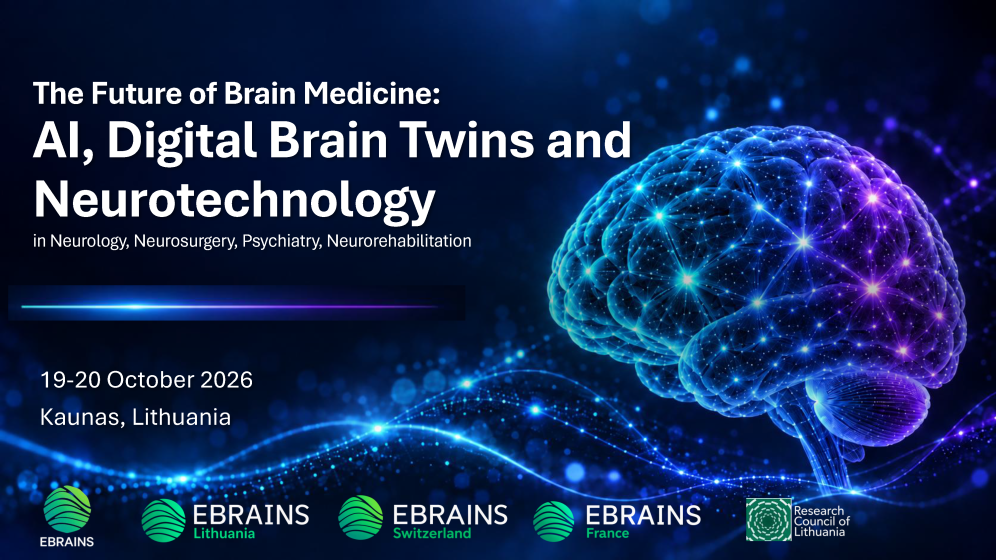
Join the EBRAINS Symposium on Neuroscience and Artificial Intelligence “The Future of Brain Medicine: AI, Digital Brain Twins and Neurotechnology in Neurology, Neurosurgery, Psychiatry, Neurorehabilitation”, which will take place at the Lithuanian University of Health Sciences in Kaunas, Lithuania, on 19–20 October 2026. Click here to find out more.
Testimonials


Switzerland Organizations




National Node News


Create an account
EBRAINS is open and free. Sign up now for complete access to our tools and services.